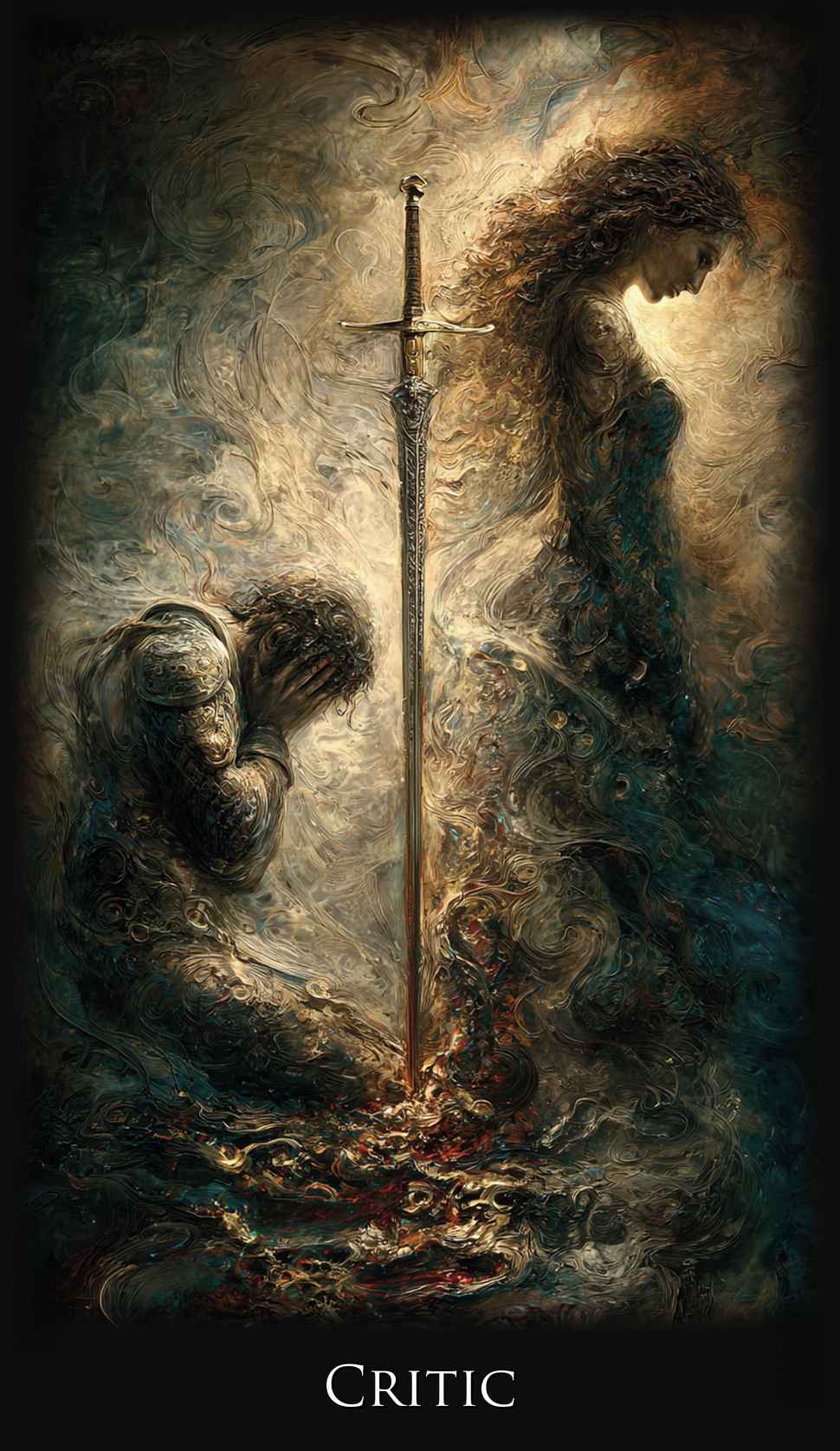
"To be alive at all is to have scars."
Knight
The Mature Knight trains because his excellence matters. As the Warrior's Warrior, he is earth meeting earth, belly meeting belly. He is the Warrior who trains.
He persists through failure. He trains through pain. He holds himself accountable, not for ego but for honor.
He is anti-fragile: every battle makes him stronger. He withstands pain, psychological and physical. He suffers willingly for his goals. Yet his strength serves honor, his mastery serves loyalty, his discipline serves a cause worth fighting for. He upholds and enforces the law, not as a bully but as a protector. Without someone willing to hold the line, agreements mean nothing and the vulnerable pay the price.
Declarations
- I persist. I give my all & do my best.
- I train for skill, strength & accuracy.
- I am anti-fragile: battles make me stronger.
- I develop mastery through self-discipline.
- I withstand pain, mental & physical.
- I am willing to suffer for what I want.
- I compete with honor.
- I accept defeat with grace & learn from it.
- I hold myself accountable to commitments.
- I uphold the law & enforce it fairly.
- I use my skills to serve something greater.
Balance: Honor & Discipline
The Knight balances Honor and Discipline. Honor is commitment to his code and integrity. Discipline is effort and self-control over time.
Honor without discipline becomes judgment from the stands: high standards aimed at everyone but himself. The Critic (active shadow) judges others from the sidelines instead of training. His honor has become a weapon against those who try rather than fuel for his own effort.
Discipline without honor becomes mercenary skill: trained but serving no noble purpose. The Mercenary (passive shadow) has skills for sale. Mastery without meaning.
The Knight holds both. He trains relentlessly and serves something greater. The Critic must step into the arena and try. The Mercenary must rediscover honor.
The Knight's Understanding
Anti-fragility: He grows stronger through stress. What breaks others builds him. He seeks the resistance that forges strength.
The arena: Only the one in the arena counts. Critics don't matter. Spectators don't matter. The Knight enters the fight.
Scars as proof: Wounds are evidence of engagement. To be alive is to have scars. He wears his losses with dignity.
Mastery as process: He never arrives. He is always becoming. Skill has no finish line, only deeper levels of understanding.
Upholding the law: The Knight upholds the rules that protect the realm. He enforces them consistently and fairly, not because he enjoys authority, but because order protects the vulnerable and keeps agreements meaningful. He holds himself to the same standard he holds others to.
Defeat as teacher: Losing teaches more than winning. He studies his failures. He learns what victory cannot teach.
The Knight's Code
- Protect the innocent and vulnerable
- Keep our word
- Face challenges with courage
- Treat opponents with respect
- Uphold the law and enforce it fairly
- Use strength in service of justice
- Never stop learning
- Accept responsibility for our actions
The Knight's Training
Excellence requires training. He shows up like an athlete, day after day. Mastery is a lifelong path.
Physical conditioning. Skill development. Mental discipline. Character building. He trains not to be ready for challenges but because training develops the qualities he needs.
The Arena
The Knight needs an arena, a place where skill meets resistance.
This might be a dojo, a gym, a field, a court, a ring. The form matters less than the function: a place where he meets his edge. Here he discovers what he's made of. Here he fails and learns. Here he faces opponents who sharpen him.
The opponent is not the enemy. The opponent is the gift. Without resistance, there is no growth. The Knight respects those who test him. He honors the one who defeats him. He learns from each loss.
His scars prove he entered the arena. He doesn't hide them. They are evidence of engagement, of risk, of willingness to be tested. The critic in the stands has no scars. The Knight has many.
Victory teaches less than defeat. When he wins, he celebrates briefly and returns to training. When he loses, he studies. What did he miss? Where was he weak? Defeat teaches what victory cannot.
Competing with Honor
Competition is the road to competence. The Knight competes not to dominate but to find his limits and push past them.
He compares himself to his past self, not to others. Yesterday's performance is the benchmark. Today he aims to be slightly better. This is the only comparison that matters.
Others are mirrors, not enemies. He watches skilled opponents to learn, not to envy. Their excellence shows him what's possible. Their victories reveal his gaps.
He wins with humility. Victory proves nothing permanent, only that today, in this contest, he was better. Tomorrow the roles may reverse. He celebrates briefly, then returns to training.
He loses with grace. Defeat stings. But he doesn't make excuses or blame circumstances. He studies what went wrong. He thanks the opponent who exposed his weakness. He gets back to work.
Honor means playing by the rules when no one watches. It means refusing shortcuts that compromise integrity. It means treating every opponent, stronger or weaker, with respect.
The Knight knows: how we compete reveals who we are.
Living as the Knight
He approaches life with dedication, discipline, and honor. He finds meaning in the daily work of getting better and holding himself to what he believes.
His satisfaction comes from the process of becoming, not from recognition or rewards.