"No one will listen to us until we listen to ourselves."
Guide
The Mature Guide walks between worlds. As the Magician's King, he brings spirit into order—fire meeting air. He is the Magician who leads.
Real wisdom holds both earthly competence and spiritual connection. He moves through material reality without losing his connection to something larger, walking between the ordinary and what lies beyond it.
He is a star dancer, connecting the heavens and the earth. He guides others not with knowledge alone but with wisdom that holds both seen and unseen, both practical and mystical. His guidance comes from lived experience.
Declarations
- I use my skills to guide & serve the greater.
- I am thoughtful, reflective & detached.
- I learn & teach. I honor my teachers.
- I guide, teach & share my knowledge.
- I seek & steward sacred space.
- I connect the heavens and the earth.
- I balance worldly skill & spirit.
- I embody the divine & engage the world.
Balance: Worldliness & Spirituality
The Guide balances Worldliness and Spirituality. Worldliness is understanding practical matters and human nature. Spirituality is connection to the sacred and the numinous.
Worldliness without spirituality becomes cynicism: competent but disconnected from the sacred. The Infidel (active shadow) uses knowledge for personal gain, disconnected from higher purpose.
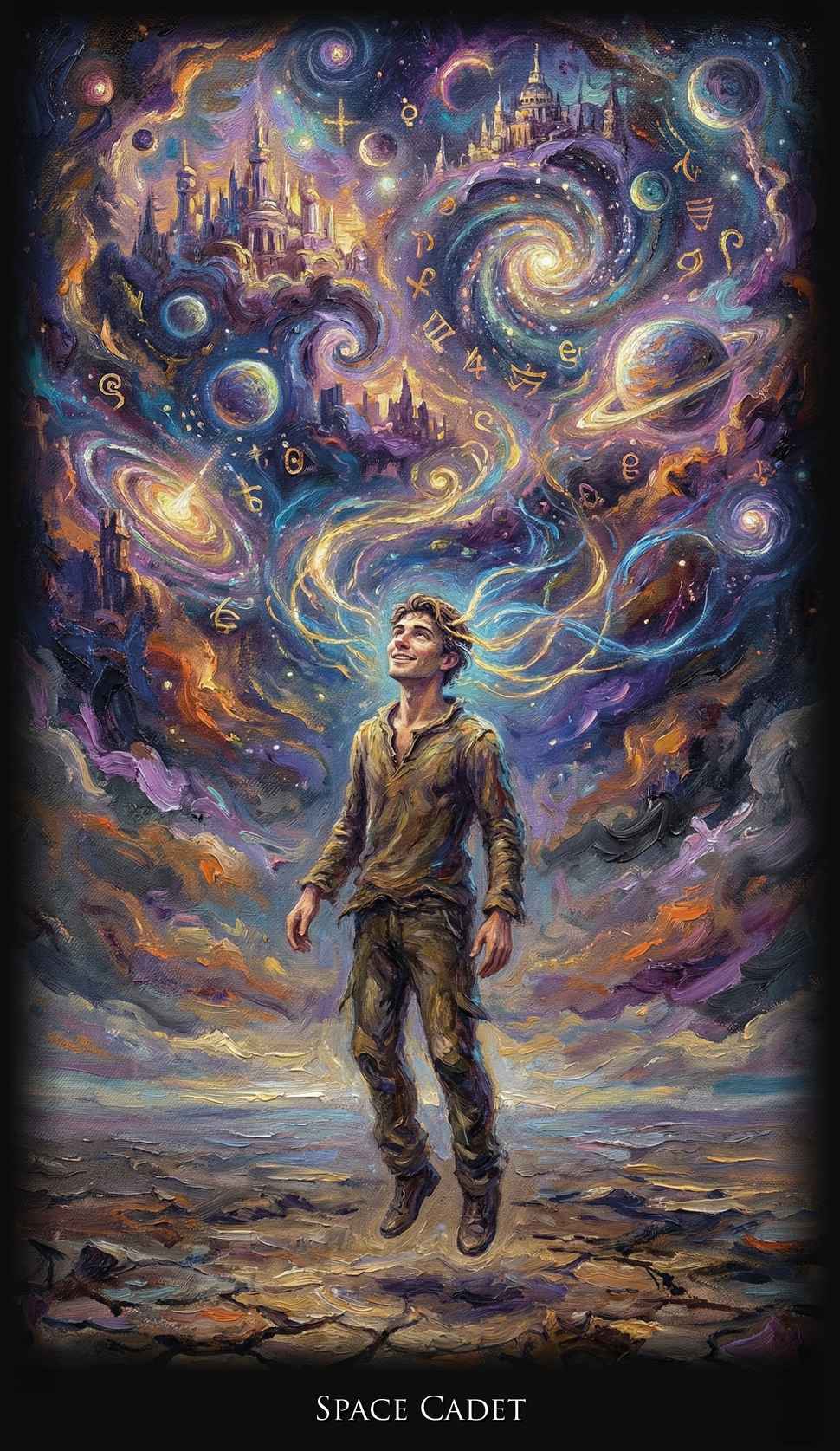
Spirituality without worldliness becomes impracticality: connected to the divine but unable to function. The Space Cadet (passive shadow) floats above life rather than engaging with it. His guidance doesn't work in real life.
The Guide holds both. Grounded and connected. Skillful in the world and in touch with the sacred. The Infidel must reconnect with the sacred. The Space Cadet must ground his spirituality in practical competence.
The Guide's Understanding
Both Worlds Are Real: The spiritual is not more true than the material. The practical is not more real than the sacred. The Guide refuses to choose. He lives in both.
The Map Is Not the Territory: He points toward truth but doesn't own it. His teachings are fingers pointing at the moon, not the moon itself. He holds his maps lightly, knowing truth is vast.
Wisdom Requires Embodiment: Knowledge that isn't lived isn't wisdom. The Guide teaches what he has walked. His authority comes from integration, not information.
Each Path Is Unique: He guides without prescribing. What worked for him may not work for another. He offers principles, not formulas, and leaves room for people to find their own way.
Transmission Is Alive: Wisdom passes person to person, presence to presence. Books carry information. Lineage carries transmission.
The Guide's Authority
His authority comes from integration, not position or credentials. He has walked the path himself. He has struggled with the questions his students face. He has found his own answers.
This authority is humble. He doesn't have all the answers. He points the way but doesn't claim to own the destination. He is a bridge, not a gatekeeper.
Ceremony
The Guide concerns himself with three things:
- Realization
- Actualization
- Preparation for Death
These are the thresholds the Guide tends. As translator between worlds, he holds space for transformation. This cannot be forced, only invited. His invitation is powerful.
This is why ceremony matters. Ritual marks thresholds. It says: something is happening here. Pay attention. The ordinary world pauses. Sacred time begins.
The Guide knows how to open and close these spaces. He creates containers strong enough to hold what emerges. He sets boundaries that make freedom possible. Without structure, ceremony becomes chaos. Without presence, it becomes empty form.
Sacred space is not a location. It is a quality of attention. The Guide can create it anywhere—a forest clearing, a living room, a hospital bed. What matters is intention and presence.
Ceremony serves transformation. It gives the invisible a form. It makes the internal external. It witnesses what would otherwise go unseen. The Guide understands this power. He uses it with care.
Lineage and Logos
The Guide stands in a line of teachers stretching back beyond memory. He received what he gives. Someone lit his fire. Someone pointed him toward the path.
He honors this lineage and the Dharma. Not with blind obedience but with gratitude and respect. He knows he didn't invent what he teaches. He inherited it, refined it, and made it his own.
This is the balance: deference to old wisdom and trust in inner authority. He doesn't reject tradition to seem original. He doesn't parrot tradition to seem legitimate. He receives the teaching, lives it, and passes it on—transformed.
The lineage continues through him but doesn't end with him. He develops those who will carry it forward. His success is measured not by followers but by teachers he creates.
He is a link in a chain. Strong enough to hold. Humble enough to pass it on.
Living as the Guide
He approaches life as something to be studied and served. What fills him up isn't being needed—it's the moment when someone else finally gets it.
As the Magician's King, he shows what it means to be both mystic and practical.
He maintains loving detachment. He cares deeply but doesn't attach to outcomes. He offers wisdom freely but doesn't need it accepted.
This is not coldness. Each person must walk their own path. He can point and support but cannot walk for another. His willingness to step back is what lets others step forward.